 Columbus










Torque Notes: Dual Response System

N°_03
DUAL RESPONSE SYSTEM
One wheel.
Two answers.
Most frames pick a side. A stiff one drives sharp and beats you up; a soft one smooths the road and eats your legs. The King Zydeco 2 splits those two jobs down two separate structural paths from the rear hub, so a single wheel gets two behaviors at once. Cinelli calls it the Dual Response System.

One line, two behaviors
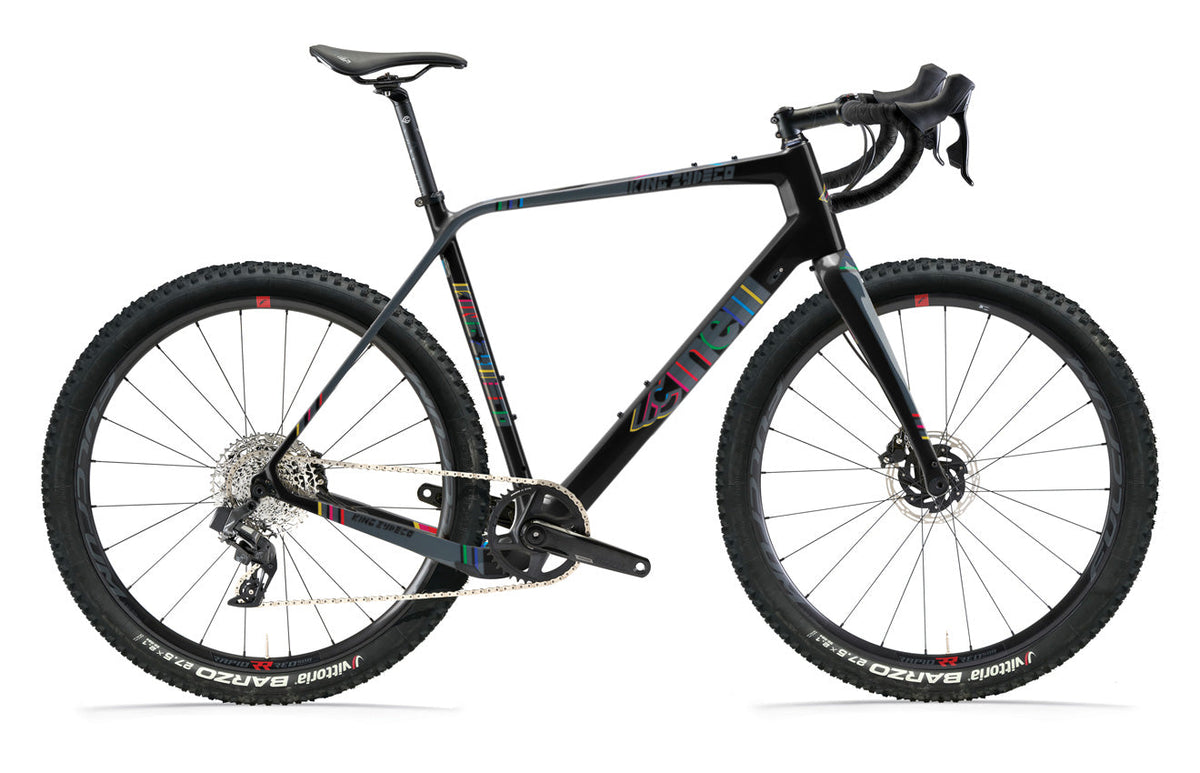
Draw a line from the top of the head tube to the rear dropout. Everything below it is built stiff. Everything above it is built to flex. You can read it straight off the tubes: deep, boxy chainstays under the line, thin flattened seatstays over it.
Both paths start at the same place. Every pedal stroke loads the rear hub, and from there the frame sends that energy down two routes that do opposite things on purpose.
Two structures, one frame
Below the line
The lower structure is short and deep. It ties the rear wheel to the bottom bracket, then carries the same stiffness forward into the head tube. Power you put through the pedals reaches the road with little lost to frame flex, and the front end holds its line when you sprint or dive into a corner.
On the King Zydeco 2 the bottom bracket is 5% stiffer than the first generation, and a more compact main triangle firms up the front end.
Above the line
The upper structure runs as one continuous carbon lay-up, with the fibers aligned to pass unbroken through the seat cluster. That lets it flex where a rider feels road buzz the most, damping vibration before it reaches the seatpost.
The gain is comfort that doesn't cost handling. Less vibration through the saddle means less fatigue over long, rough hours, and the steering stays as direct as Zone A makes it.
Built low, built short
Deep chainstays sit low around the bottom bracket. Dropping them where clearance is hardest to find opens room for 45 mm tires without stretching the back of the bike to get it.
So the rear end stays short. Chainstays hold at 430 mm, the wheelbase stays contained at 1,032 mm in size M, and the frame runs both 700c and 650b wheels. A 52 mm fork offset gives roughly 57 mm of trail on a 38 mm tire, quick steering for a gravel bike, which keeps it sharp into corners and fast to change direction.
What the system targets
Plotted against a conventional single-behavior layout, the shape is the whole point: hold stiffness and reactivity high, and pull compliance and comfort up at the same time instead of trading one for the other.
What changed
The frame kit dropped 400 g against the first King Zydeco, about 15% of kit weight. Roughly 273 g of that comes from the Columbus Components integrated bar and seatpost, another 92 g from reshaping the frame itself. Frame and fork together are 6% lighter.
Stiffness held while the weight came off: bottom bracket up 5%, front end firmer from the more compact main triangle. Cinelli also added an XS size, smoothed the stack-and-reach steps between sizes for cleaner fitting, and revised the front derailleur area so the frame now takes modern road groupsets up to 52×36.
| Parameter | King Zydeco 2 |
|---|---|
| Frame material | Columbus carbon monocoque |
| Frame weight (M) | 1,130 g (±5%, painted) |
| Fork weight (uncut) | 456 g (±5%, painted) |
| Max tire clearance | 700×45 mm (measured) · 650b + 700c |
| Chainstay length | 430 mm (all sizes) |
| Wheelbase | 1,009 mm (XS) → 1,054 mm (XL) |
| Head angle | 70.5° → 72.5° |
| Seat angle | 72.5° → 74° |
| Sizes | XS · S · M · L · XL |
| BB shell | Press Fit 86.5 × 41 mm |
| Headset | IS 52/28.6 · IS 52/40 |
| Cockpit | Columbus Components Cento integrated bar |
| Seatpost | Cinelli proprietary · double offset −10 / −20 mm |
| Cable routing | Full internal · mechanical + electronic |
| Standards | UDH ready · UCI approved |
| Colors | Orange Safari · Bayou |


